

The authors from the Querques lab: Thomas Swartjes, Iana Hammerschmid, first author Mateusz Walter and group leader Irma Querques (from left to right). © Max Perutz Labs
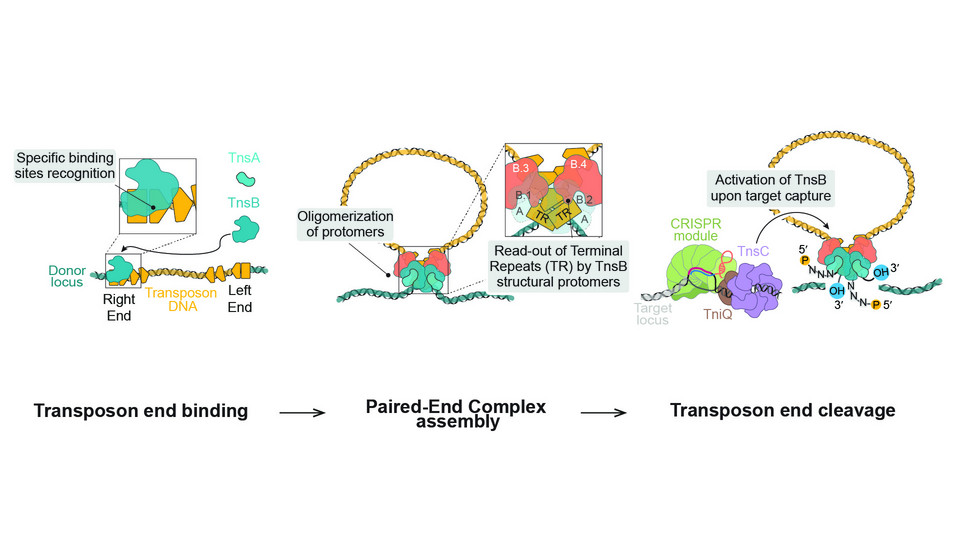
Our work revealed that cut-and-paste transposition by type I-F CASTs relies on a series of molecular checkpoints controlling transposon end recognition, transposase oligomerization, and activation prior to DNA cleavage. Together, these checkpoints ensure efficient and high-fidelity transposition, both in nature and for genome engineering applications. © Mateusz Walter
Transposons – also known as ‘jumping’ or ‘selfish’ genes – are DNA sequences that move within and between genomes. CRISPR-associated transposons (CASTs) combine nuclease activity-deficient CRISPR machinery with transposon enzymes to enable RNA-guided, site-specific DNA integration without generating double-strand breaks. First predicted bioinformatically in 2017 and experimentally demonstrated in 2019, CASTs have emerged as promising systems for precise, targeted gene insertion. However, much remains unknown about how CASTs control their transposition. Understanding these molecular mechanisms is essential for harnessing their potential for precise and predictable genome engineering.
This was the starting point for the Querques lab. Focusing on a special CAST from the gram-negative bacterium Pseudoalteromonas (PseCAST), a particularly efficient system capable of highly specific RNA-guided ‘cut-and-paste’ transposition, the researchers set out to understand the molecular basis of its precision. By combining cryo-EM structural analysis with biochemical assays, they reconstructed individual stages of the transposition reaction, thereby elucidating the mechanism by which transposase activity is controlled. “We found that a single protein can coordinate DNA binding and cleavage through a tightly regulated process of self-assembly,” says PhD researcher Mateusz Walter, first author of the study. Self-assembly, the scientists found, is therefore not simply a structural feature of the transposase, but a key mechanism controlling its activity.
“We found that the system is governed by a series of molecular checkpoints that ensure highly precise transposition,” explains group leader Irma Querques. These checkpoints act at several stages of the reaction: the transposase first recognizes the transposon ends with high sequence specificity, which must then pair correctly to form a complex capable of DNA excision. Excision seems to be further coordinated with the CRISPR-transposon targeting machinery, linking processing of the transposon ends to the capture of an appropriate target. Conceptually, this mechanism may prevent loss of the transposon by directly coupling the ‘cut’ and ‘paste’ steps of the reaction. By reconstituting the reaction in vitro, the researchers could dissect these steps individually and demonstrate that DNA excision occurs with nucleotide-level precision. The authors’ structures also revealed a dual role for the DNA sequences that demarcate the boundaries of the transposon: they not only specify where the transposase cuts but also promote assembly of the transposase tetramer required for excision. Together, the findings reveal how proteins and nucleic acids work in concert to tightly control transposition.
The study combined complementary expertise in biochemistry, structural biology and in vivo experiments: the Querques lab performed the biochemical reconstitution and mechanistic characterization, the Jinek lab at the University of Zurich performed the structural analysis of the protein–DNA complexes, and the Sternberg lab at Columbia University in New York investigated transposition in E. coli. Together, the work provides a mechanistic framework for understanding CAST transposition – and a molecular rulebook for engineering these systems in the future.
DOI: 10.1038/s41467-026-76893-7