


Group leader Elif Karagöz (left) together with first author Aleksandra Anisimova. (c) Max Perutz Labs
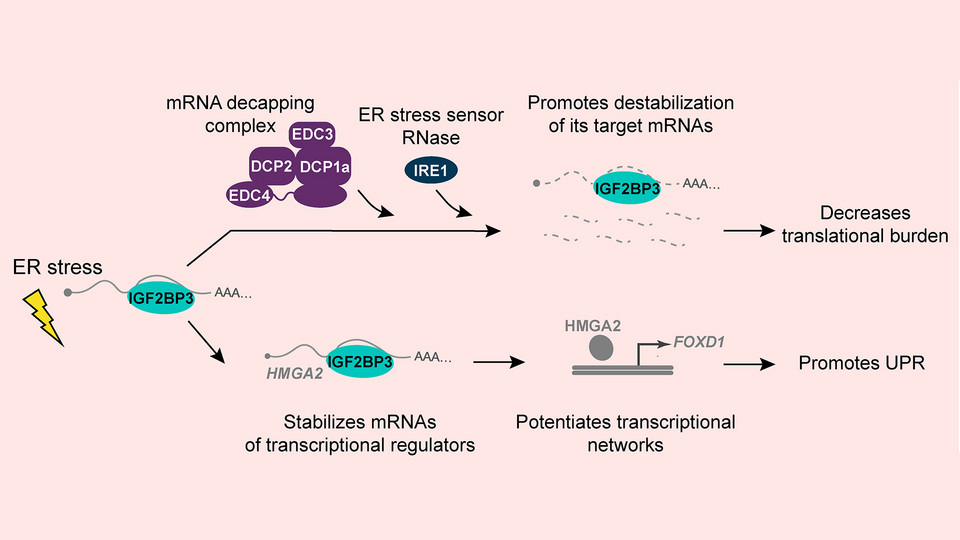
IGF2BP3 supports the cellular response to endoplasmic reticulum stress through two distinct mechanisms: it promotes the selective transcriptional upregulation of stress-response genes while simultaneously driving widespread mRNA degradation to reduce protein folding load until stress is resolved. (C) Aleksandra Anisimova
The unfolded protein response (UPR) is activated when misfolded proteins accumulate in the ER, triggering pathways that restore protein folding homeostasis or, if stress persists, that lead to cell death. While much is known about transcriptional programs that modify folding capacity, less is understood about how cells rapidly adjust protein production. One key mechanism involves reducing the influx of newly synthesized proteins into the ER, but how this is selectively controlled has remained unclear.
In their new study, the Karagöz lab identifies the RNA-binding protein IGF2BP3 as a central regulator of this process. Rather than acting in a single direction, IGF2BP3 performs a dual role: it promotes the degradation of many mRNAs while indirectly boosting the transcription of stress-response genes. “We initially thought IGF2BP3 might simply prevent cleavage of stress-response genes, but the data showed a completely different and more complex mechanism,” says first author Aleksandra Anisimova. Together, these activities establish a feedback loop that reduces protein load while ensuring the continued production of key adaptive factors.
Mechanistically, ER stress triggers a functional switch in IGF2BP3. Normally associated with mRNA stabilization, the protein responds to stress conditions by engaging the RNA decay machinery. “It shifts from a stabilizer to a degrader during ER stress,” explains group leader Elif Karagöz. This shift is essential: without IGF2BP3, cells fail to restrain protein synthesis, leading to protein misfolding, aggregation, and disrupted cellular homeostasis.
Beyond stress adaptation, the findings also connect ER regulation to cancer biology. By influencing a transcription factor linked to proliferation, IGF2BP3 may help cancer cells exploit stress-response pathways to support growth and survival. Its ability to switch functions depending on context highlights a broader principle of regulatory plasticity in cellular stress responses.
Looking ahead, the researchers aim to understand how IGF2BP3 interacts with the RNA decay machinery at the molecular level and how this interaction is controlled during development and cancer progression. Elucidating how this ‘multi-trick’ regulator alternates between stabilizing and degrading mRNAs will be key to understanding how cells restore homeostasis during and after stress – and how this delicate balance is disrupted in disease.
DOI: 10.1101/gad.353291.125