

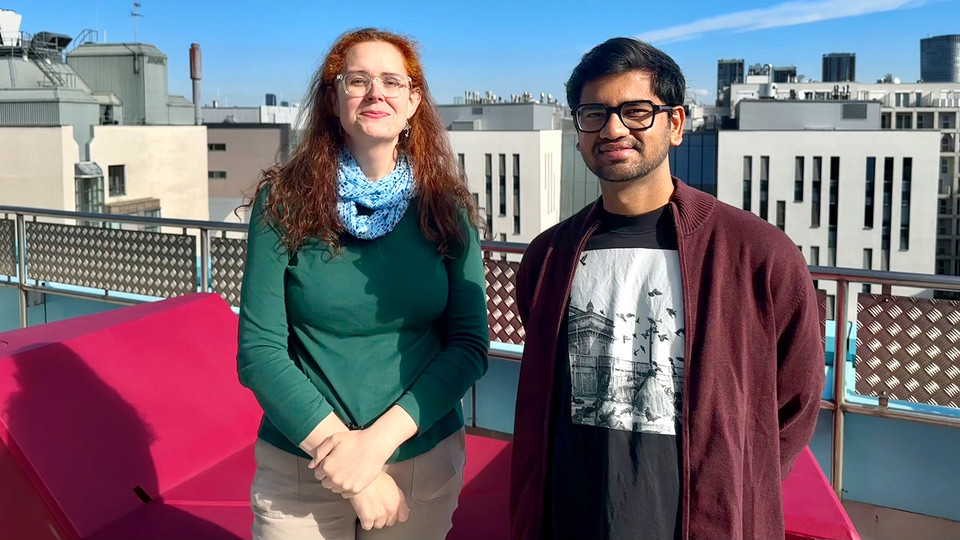
The two VIP³ fellows at the Perutz: Rachel Anderson and Harsh Ranawat. © Max Perutz Labs
RNA metabolism is essential for neuronal health, and its disruption is increasingly linked to neurodegenerative disease. In her VIP³-funded project in the Hallacli lab, Rachel Anderson will investigate how aggregates of the Parkinson’s-associated protein alpha-synuclein interfere with processing bodies, cellular compartments involved in RNA metabolism, and whether this disruption contributes to neuronal toxicity. The project will be co-mentored by group leader Stefan Ameres, combining expertise in Parkinson’s disease models with approaches to measure and quantify RNA fate. Rachel explains: “I want to understand whether the disruption of RNA metabolism by alpha-synuclein can help explain how this protein becomes toxic in the brain.” Rachel studied Biochemistry at the University of Colorado Boulder and completed her PhD at Massachusetts Institute of Technology, Cambridge, where she investigated dysregulated RNA processing in repeat-expansion disorders, including Huntington’s disease, before moving to the Perutz for her postdoctoral research.
Tardigrades can survive extreme environmental conditions by entering a state of suspended animation, but how their cells are organized to survive desiccation and rehydration is still poorly understood. Harsh Ranawat (Köhler lab) will investigate whether this resilience depends on a constitutively assembled cytoplasmic structures that may need to undergo preservation or remodeling. Co-mentored by group leader Sven Klumpe (IMP/IMBA), who brings expertise in in situ cryo-EM, Harsh will combine biochemical approaches with cryo-electron tomography of FIB-milled tardigrade storage cells to identify and characterize previously undescribed structures in their native cellular context. “I want to understand whether extreme stress tolerance depends not only on repairing damage, but on how the cell interior is organized to prevent that damage in the first place”, says Harsh. He completed his Master’s degree in Biophysics at Ulm University and his PhD at EMBL Heidelberg, where he studied the structural biology of Asgard archaeal chromatin.
The VIP³ fellowship includes an interdisciplinary, VBC-wide mentoring scheme, opportunities for research secondments of up to six months, and access to an international network of seven associated partner-institutions in Europe, the US and Asia.