

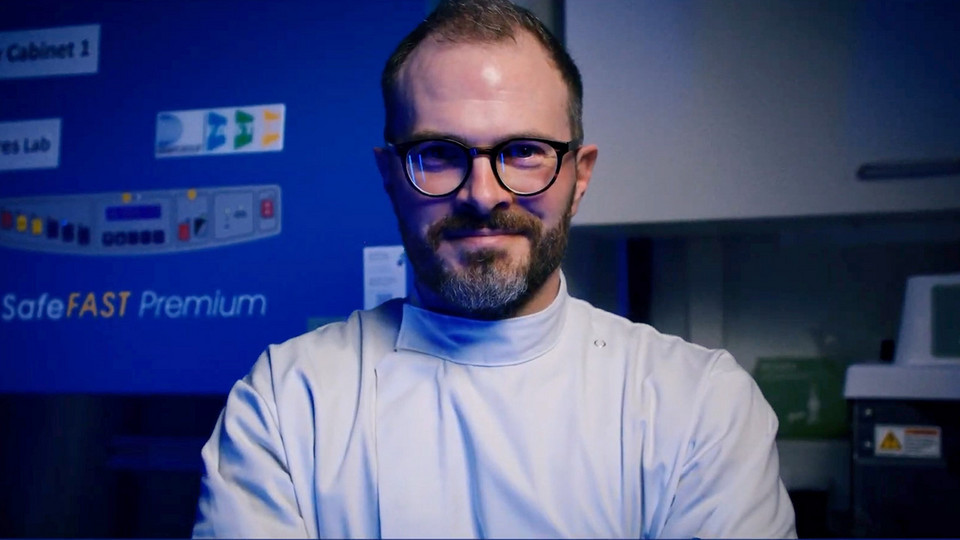
The Medical University's Researcher of the Month September: Marco Hein
A defining feature of eukaryotic cells is their organization into specialized compartments, where proteins must be precisely positioned to function properly. In their study, published in Cell, Marco Hein and colleagues combined targeted organelle enrichment with mass spectrometry to create a comprehensive map of protein localization. The approach combines subcellular fractionation with the immunoprecipitation of specific organelle marker proteins to enrich different organelles, followed by the identification and quantification of their associated proteomes. “Our protocol aims to break down the cell mechanically while largely preserving the structural integrity of subcellular structures,” explains Perutz group leader Marco Hein. “This method allows us to isolate all organic material linked to the marker protein.” Using this strategy, the researchers assigned around 7,600 proteins to one of 20 subcellular compartments, creating a detailed map of their distribution.
The method can also reveal how protein localization changes under different conditions. When the researchers applied it to cells infected with the human coronavirus OC43, they found that many proteins changed their subcellular localization without significant changes in their overall abundance. This suggests that re-localization of proteins within the cell may be an important mechanism to control cell physiology. The study provides both a valuable database of protein localization and a new tool for studying how subcellular organization changes in response to a perturbation such as infection or treatment with a drug.