

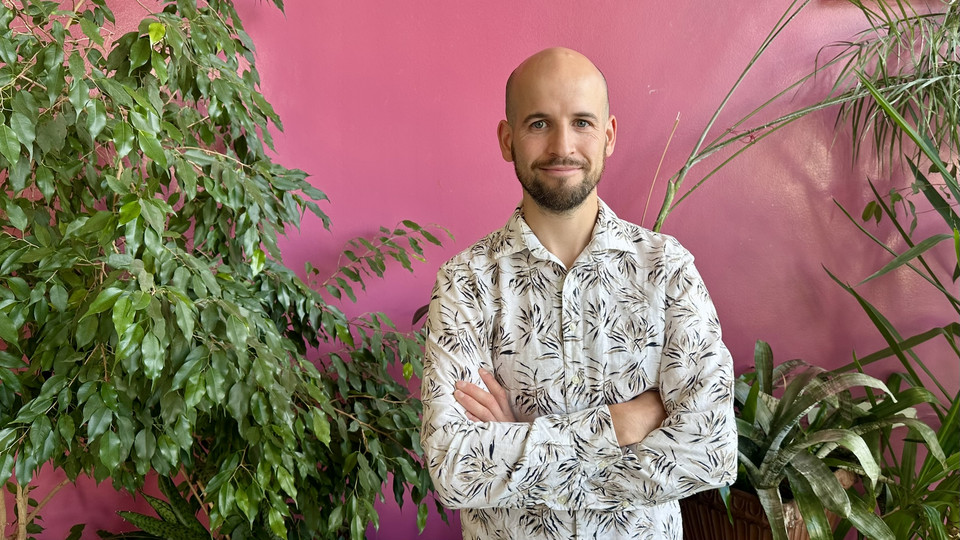
ESPRIT Fellow Marek Kravec. © Max Perutz Labs
Autophagy helps rid cells of damaged or unnecessary material by packaging it into autophagosomes for delivery to lysosomes, where the material is degraded and recycled. However, precisely how the machinery is organized at the endoplasmic reticulum (ER) remains only partially understood. With his recent FWF ESPRIT fellowship, Marek Kravec from the Martens lab will investigate how ER-localized VAP proteins coordinate autophagy factors during autophagosome formation by combining biochemical, cellular and computational approaches. Marek says: “We want to understand how VAP proteins help organize the autophagy machinery at the ER and thereby contribute to the spatial control of autophagosome biogenesis.” Marek completed his undergraduate studies and PhD at Masaryk University in Brno, where he studied Wnt signaling, followed by a postdoctoral position at the Institute of Biotechnology of the Czech Academy of Sciences in Prague, before joining the Martens lab at the Perutz in 2024.
About the ESPRIT fellowship
The FWF’s ESPRIT program (Early-Stage Program: Research – Innovation – Training) enables early-career postdoctoral researchers from all disciplines to pursue their own research projects at Austrian institutions. Beyond funding innovative research, the fellowship is designed to help researchers build an independent scientific profile and take the next step in their academic careers, while also bringing international talent into Austria’s research landscape. ESPRIT funding is available for up to three years and covers both the fellow’s salary and project-related research costs.