

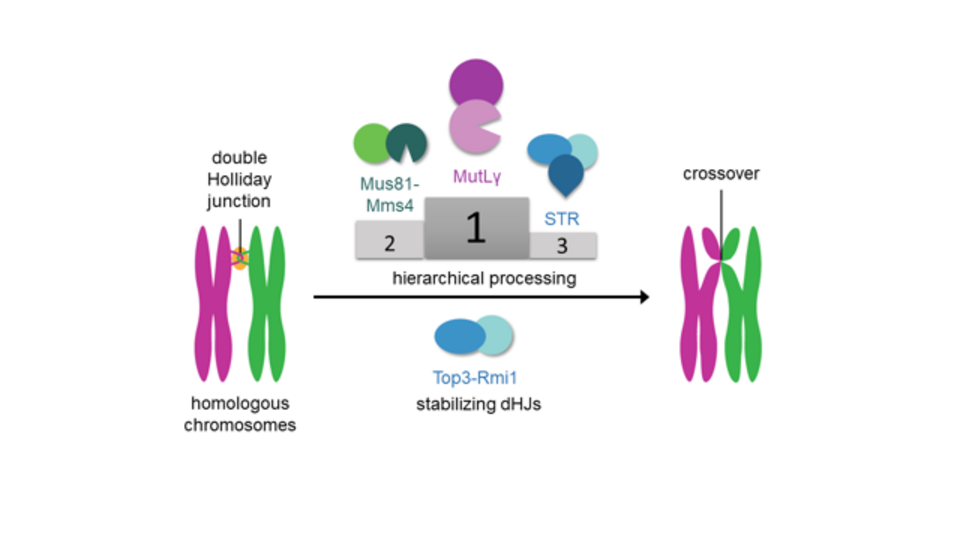
Crossovers – the exchange of genetic material between homologous chromosomes – arise from programmed DNA double-strand breaks (DSBs). The two ends of the DSB are resected to form 3’ single-stranded DNA overhangs, which are then capable of invading DNA sequences in the homologous chromosome. These recombination intermediates are transient and processed by multiple repair enzymes, making it difficult to resolve the contribution of each pathway in vivo. To overcome this challenge, the Matos lab developed an engineered yeast system that stabilizes specific recombination intermediates, called double Holliday junctions, and allows each resolution pathway to be tested independently. “What Lucija did is to construct a system that fixes the substrate and then allows her to interrogate one by one what each of the enzymes can do”, explains group leader Joao Matos.
Using this system, the researchers showed that MutLγ is the only one capable of producing exclusively crossovers, while structure-selective nucleases generate a mixture of crossovers and non-crossovers, and the Sgs1-Top3-Rmi1 (STR) complex primarily produces non-crossovers. “Only one of the enzymes really has the ability to specifically generate crossovers out of these intermediates – MutLγ”, says first author Lucija Orlić. The study further revealed a functional hierarchy among these enzymes: MutLγ acts first and most efficiently on recombination intermediates, ensuring that crossovers are preferentially formed. However, if some intermediates escape this primary pathway or are not processed quickly enough, backup nucleases are recruited to resolve the remaining DNA structures and prevent chromosome segregation defects. STR forms the final layer in this hierarchy, slowly dismantling persistent intermediates into non-crossovers to ensure that meiosis can still be completed successfully.
An unexpected finding was the role of Top3, a topoisomerase traditionally associated with generating non-crossovers by ‘dissolving’ recombination intermediates. The study reveals that Top3 is also required for the stabilization of double Holliday junctions that are compatible with MutLγ processing. Without Top3, crossover formation is severely impaired. “Top3 is needed for the maintenance of a specific structural topology that can be cleaved by MutLγ – the enzyme that makes crossovers”, Joao explains. The precise role of Top3 in this context is still being investigated, but it may help maintain recombination intermediates in a structural state that is compatible with other chromatin-associated processes during meiotic prophase.
The Matos lab is now investigating whether and how recombination intermediates can be moved along chromosomes, influenced by processes such as transcription. Crossover sites may be determined not only by where DNA breaks initially form, but also by where the resulting junctions migrate to before they are resolved. “We hypothesize that the crossover sites will not be dictated only by where the breaks were formed – they will be dictated by where the junction is eventually moved to on the DNA”, says Joao.
DOI: 10.1038/s41467-026-73888-2