

The project began with a phosphoproteomics screen designed to identify targets of the Polo kinase Cdc5, which is involved in meiotic crossover formation. Rather than pointing exclusively to known recombination factors, the screen uncovered an unexpected candidate: a component of the nuclear pore complex (NPC). Group leader Joao Matos recalls: “One of the main hits of the screen was Nup60, a protein of the NPC which anchors the basket to the core NPC. Components of the NPC have, to date, not been implicated in the pathways we typically work on in the lab.” This surprising observation prompted the team to investigate whether there was a connection between the NPC and meiotic recombination, work which led to the discovery of a new mechanism that influences the resolution of crossover events in conjunction with chromosome synapsis.
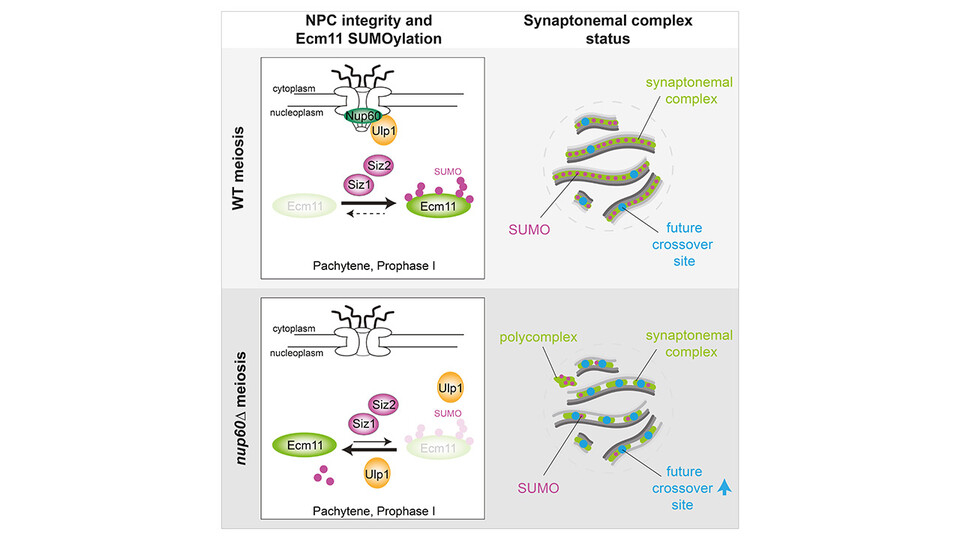
The scientists found that deleting NUP60 or other nuclear pore basket components in yeast led to the unscheduled de-SUMOylation of proteins within the synaptonemal complex, a structure essential for crossover control during meiosis. It was previously known that Nup60 also acts as a docking site for multiple proteins, including the SUMO protease 1. Experiments showed that sequestration of the SUMO protease Ulp1 prevents it from prematurely de-SUMOylating key meiotic proteins. First author Rahel Wettstein explains: “The basket is a anchor site for Ulp1, such that its activity can be spatially and possibly temporally controlled during meiosis.” By spatially constraining Ulp1 activity, the NPC helps maintain the molecular environment required for precise crossover formation and resolution, ultimately required for successful gamete formation.
Beyond its implications for meiosis, the study highlights how spatial organization contributes to SUMO regulation: SUMOylation depends not only on the activity of enzymes that add or remove SUMO modifications, but also on where those enzymes are located within the cell. Joao explains: “For the precise regulation of cellular processes by SUMOylation, you need to restrain the activity of the SUMO proteases that remove the modification.” The team’s findings extend previous work demonstrating that the nuclear pore complex is more than just a transport gateway, revealing a previously unknown role in meiosis as a hub of biochemical regulation. “Conceptually, the nuclear pore basket safeguards meiotic recombination by spatially restraining Ulp1 activity, thereby preserving the structure and function of the synaptonemal complex to ensure the faithful orchestration of meiotic recombination”, says Rahel.
The study underscores the value of curiosity-driven research and long-term scientific collaboration. What began as an unbiased screen for targets of the meiotic kinase Cdc5 ultimately uncovered an unexpected role of the nuclear pore complex in the regulation of SUMOylation and crossover formation. The team’s collaboration with the lab of Elçin Ünal at the University of California, Berkeley provided key expertise in live cell imaging that helped the researchers dissect the underlying mechanism. “When you do unbiased screens, you can discover new links between pathways that you didn't know were connected”, concludes Joao.