

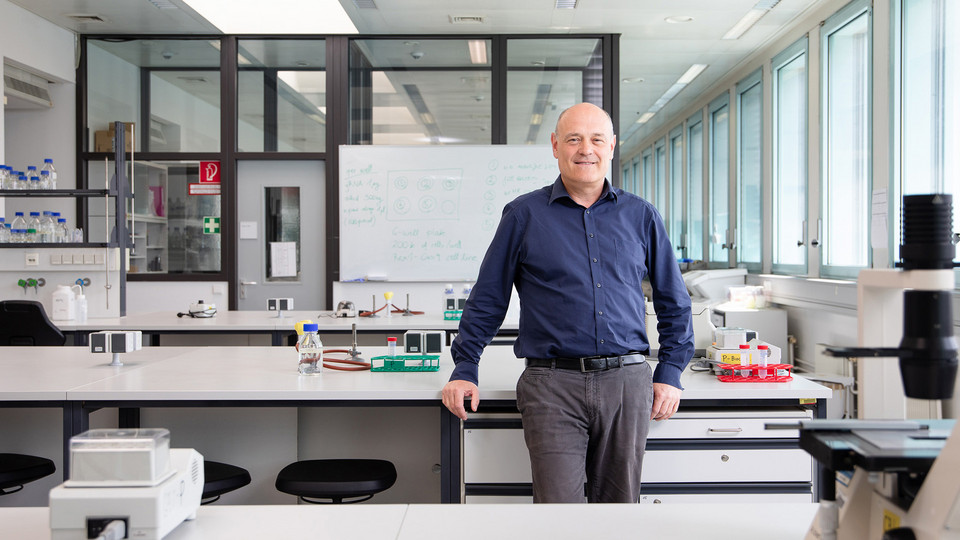
Perutz group leader Peter Fuchs. © Max Kropitz/Max Perutz Labs
The keratin network of intermediate filaments helps epithelial cells withstand mechanical and environmental stress, but how this protective system is regulated remains poorly understood. In his new FWF-funded project, Peter Fuchs will investigate how the protein epiplakin (EPPK) modulates keratin organization and contributes to skin homeostasis under stress, including UV exposure and bacterial challenge. Peter explains: “Our previous work showed that EPPK associates with keratin filaments when intracellular calcium levels rise, suggesting that it may help cells remodel their cytoskeleton. Now, we want to examine how EPPK localization and function change across different layers of the epidermis in response to stress.” To address these questions, the team will combine organotypic human skin models and mouse models with single-cell transcriptomics and live multiphoton imaging. The project will be carried out in collaboration with the Mildner and Pfisterer labs at the Medical University of Vienna, whose expertise in skin models, single-cell transcriptomics and advanced bio-optical imaging will complement work in the Fuchs lab at the Perutz.