

Having too many or too few chromosomes, a condition known as aneuploidy, is usually bad news for cells. It disrupts the delicate balance of gene expression and is generally not tolerated in developing embryos. However, aneuploidy is one of the most common genetic alterations in cancer. Under selective pressure – such as the exposure to drugs – cells can turn this disadvantage into a growth advantage. Aneuploidy is frequently observed as a mechanism of cellular adaptation, and its link to drug resistance makes it a key focus for understanding and potentially improving cancer treatment.
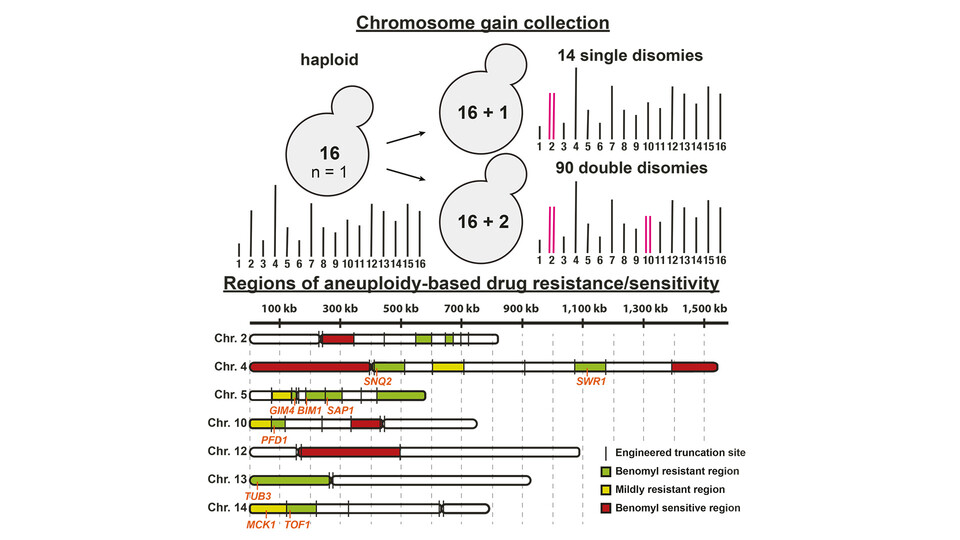
To explore aneuploidy systematically, the Campbell lab developed a unique resource: a large, engineered yeast collection of stable strains carrying different aneuploid chromosome combinations. This resource, the most extensive of its kind, allows researchers to systematically study how aneuploidy shapes cellular behavior. From drug resistance to basic cellular processes, the collection opens the door to high-throughput, controlled experiments and has already drawn attention from the wider research community.
What the team discovered is that rather than single genes driving adaptation, it is the combined effect of many small changes that matters. Even modest increases in gene expression – like those caused by an extra chromosome – can boost survival under stress. As Perutz group leader Chris Campbell explains: “The strongest effects are primarily between synergistic interactions, either within a chromosome or between chromosomes. It’s really the combinatorial effect of having many of these genes slightly overexpressed that then leads to resistance.” In other words, it’s not one powerful change in expression, but many subtle shifts working together that make the difference. The strongest resistance phenotypes emerged when multiple aneuploid chromosomes were combined, reinforcing the idea that cooperation between genes is key.
Beyond the scientists’ findings, the yeast collection itself is a valuable contribution to the research community. It provides a versatile platform for future discoveries, as first author and main developer of the resource, Sophie Koller shares: “The applications are essentially open-ended – this collection lets us explore how aneuploid chromosomes alter cellular behavior in ways we couldn’t test before, and it opens the door to countless new questions about how genes work together.” With tools like this, researchers are now better equipped to unravel how small genetic changes combine to shape life at the cellular level. The findings not only deepen our understanding of cellular adaptation but also highlight why identifying single ‘driver genes’ in cancer can be so difficult.
DOI: 10.1038/s44319-026-00767-8