

First author Luis Miguel Cerron-Alvan (left) together with group leader Martin Leeb (right). © Max Perutz Labs
Group photo of all authors. From left to right: Martin Leeb, Luis Miguel Cerron-Alvan, Triin Laos, Michelle Huth, Michael Bindl, Leonie Drakos, Mattia Pitasi. Not pictured: Tatiana Firfa, Anna Löbker. © Max Perutz Labs
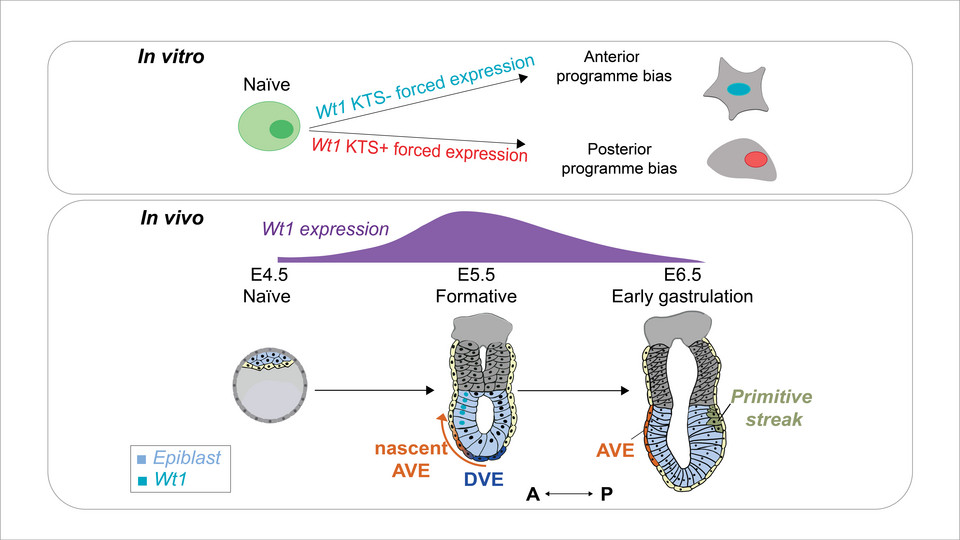
In vitro, WT1 KTS− and KTS+ isoforms bias anterior and posterior transcriptional programmes, respectively. In vivo, Wt1 expression transiently peaks during formative pluripotency and is associated with stronger anterior programme activity in the early mouse embryo. © Leeb Lab
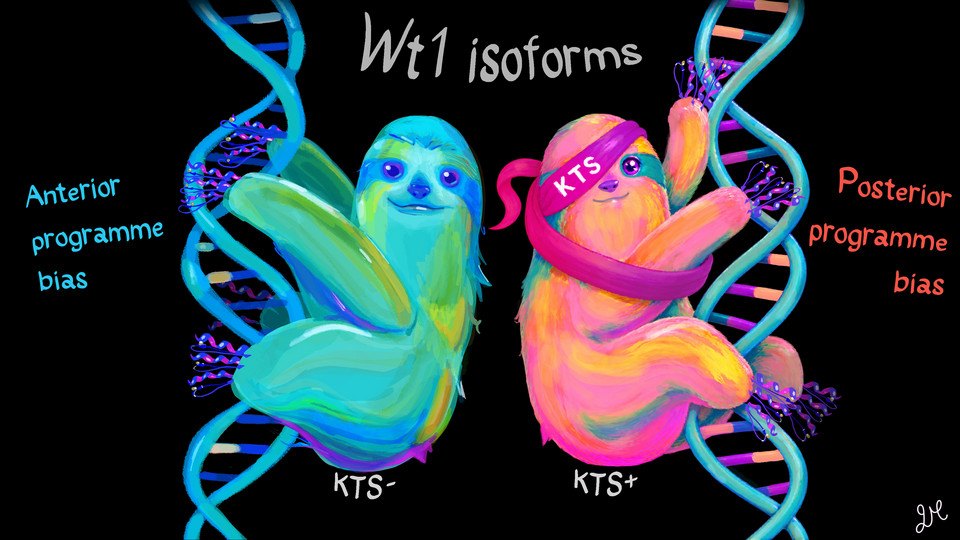
Artistic interpretation of WT1 KTS− and KTS+ isoforms and their distinct developmental biases. The illustration is not intended as a strict scientific representation. © Luis Miguel Cerron-Alvan
During the transition from naïve to formative pluripotency, cells in the epiblast begin to acquire subtle differences that will later help establish the anterior–posterior axis of the embryo. At this stage, future developmental paths are not yet fixed, but the first molecular asymmetries are already beginning to emerge. How these differences are initiated, however, has remained unclear. Searching for regulators that could actively drive cells out of naïve pluripotency and into the formative state, the Leeb lab identified Wt1 – a gene well known for its roles in development and cancer, but whose function at this very early stage had largely escaped attention. One reason may be timing: WT1 is only transiently expressed during a narrow developmental window around implantation into the uterus before its levels decline again before gastrulation.
To uncover what Wt1 is doing during this brief window, PhD student Luis Miguel Cerron-Alvan used CRISPR activation (CRISPRa), an approach that switches genes on rather than disrupting them. This allowed the researchers to turn the usual genetic question around: instead of asking whether a gene is required for a developmental process, as in conventional loss-of-function studies, they could ask whether activating it is sufficient to set that process in motion. The experiments revealed that Wt1 acts before overt lineage specification, pushing cells toward different developmental programs during the peri-implantation period, while their identities are still flexible. But the biggest surprise came when the team looked more closely at different WT1 splice isoforms: the presence or absence of just three amino acids – a KTS sequence – was enough to shift cells toward different lineage programs.
“There are only a few examples in development where different isoforms of the same gene lead to different outcomes. It adds a layer of complexity that is difficult to dissect and is sometimes overlooked, but our results show that this layer can be extremely important,” says group leader Martin Leeb. Beyond Wt1 itself, the findings point to a broader view of how developmental decisions are made. Rather than occurring as a series of abrupt switches, early cell-fate decisions may be preceded by subtle molecular differences that bias cells toward particular developmental trajectories, before later signals reinforce and consolidate these biases.
This perspective may also be relevant beyond embryonic development. “Wt1 splice isoforms clearly have different instructive roles in biasing lineage programs. If we think of cancer, in a simplified sense, as a disease in which cells lose control over their identity and regulatory programs, these findings may also put Wt1’s role in cancer into a new perspective”, says Luis. In this context, the isoform-specific effects of Wt1 also raise an important question: whether the same molecular differences that help steer developmental decisions could contribute to Wt1’s complex, context-dependent roles in cancer. Exploring this hypothesis could be an interesting direction for future research.
DOI: 10.1038/s41467-026-79258-2