Group Andreas Bachmair

Protein modification in plants

On this page

The Question

We all want to have a long life in good health. This is impossible without high-quality food. Our group is interested in finding out how plants can grow well even if environmental conditions are challenging. Knowledge about resilience mechanisms in the model plant Arabidopsis can help to improve crop plants, to ensure high quality and quantity harvests as a basis for healthy human nutrition.

The Approach

Adaptation of plants to changing environmental conditions requires sophisticated signal transduction and compensation strategies. Virtually all signal transduction pathways encompass steps to modify proteins already present in the cell. Such posttranslational modifications can occur by attaching a small protein to the substrate. The modifier proteins ubiquitin and small ubiquitin-related modifier (SUMO) are the focus of our research. We use biochemical and genetic tools to study modification pathways, in particular the N-degron pathway of ubiquitin-dependent protein degradation, and a more recently discovered pathway where multiple SUMO moieties act as degradation signal. Both pathways have important functions in environmental adaptation.

Andreas Bachmair

Andreas Bachmair studied in Vienna, where he also got his PhD (with Helmut Ruis, 1984). After a postdoctoral stay with Alex Varshavsky (MIT, Cambridge, USA; 1985-1988), he stayed at the Max Planck Institute for Plant Breeding Research (Cologne, Germany) as a postdoc with Jeff Schell (1988-1991) and then joined the Institute of Botany of the University of Vienna (1991-2002). He moved to the Max Planck Institute for Plant Breeding Research (Cologne, Germany) as a group leader (2002-2008), before taking an Associate Professor position at the Max Perutz Labs. Since 2019, he is a full professor at the Max Perutz Labs.

Download CV

Main Building
Room: 5.110

   +43 1 4277 74811

Spotlights

Spotlight 1

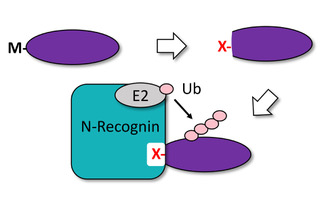
The amino terminus of a protein can be modified by proteolytic cleavage, to generate the mature protein, or a protein variant. So-called N-recognins bind to amino termini to influence the protein half-life. We are interested in N-recognins for amino-terminal Leu in plants. We identified chemical inhibitors of Leu-mediated turnover and investigate mutants in participating genes. We also reconstitute N-recognin activity by expression of plant proteins in yeast.

Spotlight 2

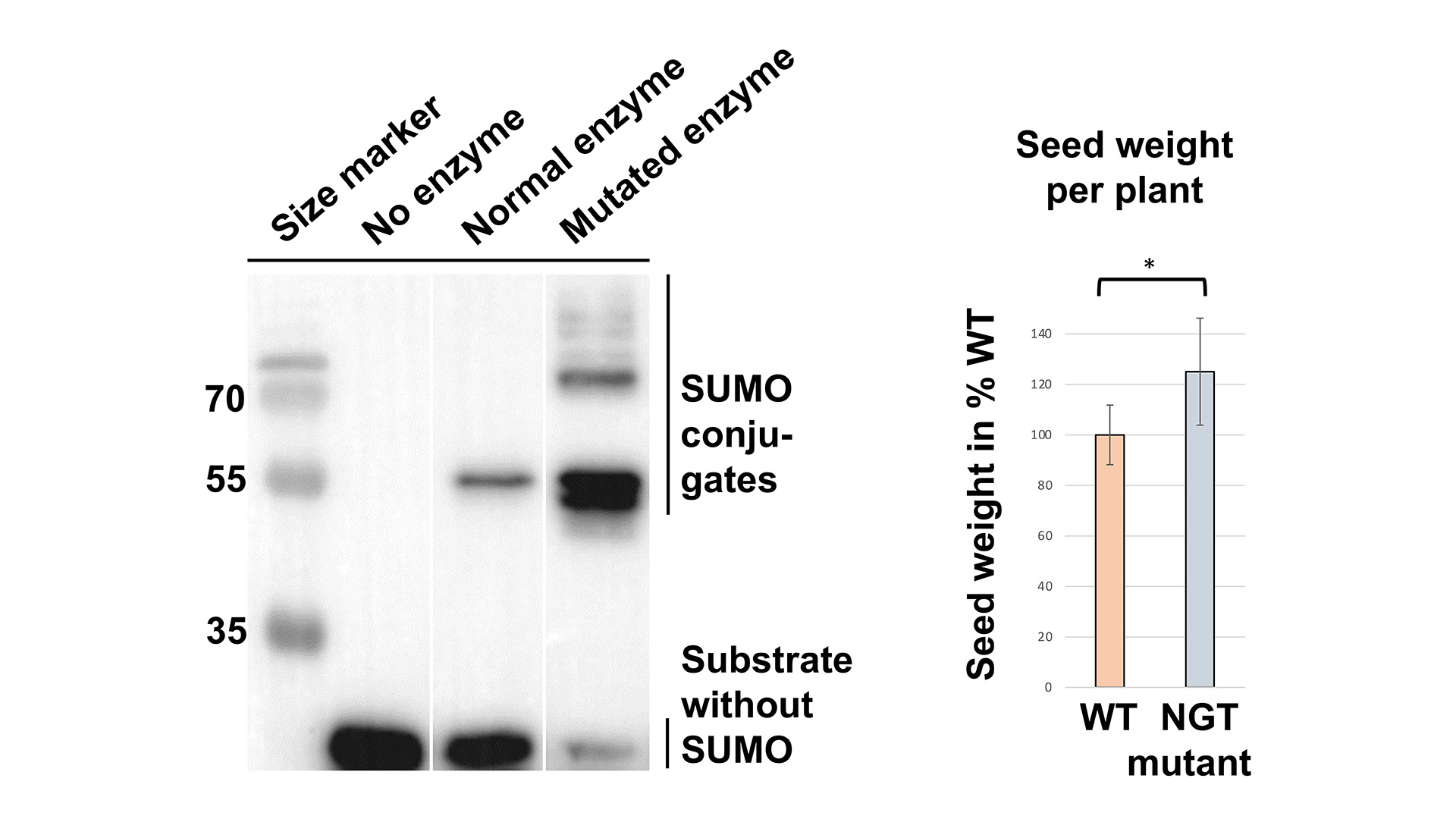
Using novel genetic techniques (NGTs), we mutated a single base pair in a gene of SUMO conjugation, to enhance this process in the model plant Arabidopsis (see Western blot of SUMO conjugation by purified enzymes, left side). Our “NGT category 1” plants have higher seed set in the greenhouse (right side diagram, statistical significance level p=0.002), but performance in a changing environment remains to be tested (see also https://doi.org/10.1111/nph.71581). In many countries, such NGT1 plants are considered equivalent to non-transgenic plants, allowing tests outside the greenhouse. Could these plants be a blueprint for future improvements in agriculture ?

    Team

    Sadia Sabrina Alam
    PhD Student
       +43 1 4277 52810
    Room: 5.108

    Andreas Bachmair
    Group Leader
       +43 1 4277 74811
    Room: 5.110

    Lino Bauer
    Master Student
       +43 1 4277 00000
    Room: 0.000

    Bushra Ijaz
    PostDoc
       +43 1 4277 52810
    Room: 5.108

    Carolina Saad
    PostDoc
       +43 1 4277 52810
    Room: 5.108

    Bernhard Wurzinger
    PostDoc
       +43 1 4277 52810
    Room: 5.108

    Selected Publications

    The UBR Domain of Plant Ubr1 Homolog PRT6 Accommodates Basic and Hydrophobic Amino Termini for Substrate Recognition.

    2025 Journal of molecular biology;437(4):168939.
    PMID:  39799992

    Rudi Olga, Hodakova Zuzana, Farias Saad Carolina, Winter Nikola, Grishkovskaya Irina, Böhm Jessica, Jarck Greta, Schleiffer Alexander, Haselbach David, Bachmair Andreas

    BIG enhances Arg/N-degron pathway-mediated protein degradation to regulate Arabidopsis hypoxia responses and suberin deposition.

    2024 The Plant cell;36(9):3177, 3200, 3177-3200.
    PMID:  38608155

    Zhang Hongtao, Rundle Chelsea, Winter Nikola, Miricescu Alexandra, Mooney Brian C, Bachmair Andreas, Graciet Emmanuelle, Theodoulou Frederica L

    A Yeast-Based Functional Assay to Study Plant N-Degron - N-Recognin Interactions.

    2021 Frontiers in plant science;12:806129.
    PMID:  35069663

    Kozlic Aida, Winter Nikola, Telser Theresia, Reimann Jakob, Rose Katrin, Nehlin Lilian, Berckhan Sophie, Sharma Gunjan, Dambire Charlene, Boeckx Tinne, Holdsworth Michael J, Bachmair Andreas

    Cellular Control of Protein Turnover via the Modification of the Amino Terminus.

    2021 International journal of molecular sciences;22(7)
    PMID:  33805528

    Winter Nikola, Novatchkova Maria, Bachmair Andreas

    The Scope, Functions, and Dynamics of Posttranslational Protein Modifications.

    2019 Annual review of plant biology;70:119, 151, 119-151.
    PMID:  30786234

    Millar A Harvey, Heazlewood Joshua L, Giglione Carmela, Holdsworth Michael J, Bachmair Andreas, Schulze Waltraud X

    Distinct branches of the N-end rule pathway modulate the plant immune response.

    2019 The New phytologist;221(2):988, 1000, 988-1000.
    PMID:  30117535

    Vicente Jorge, Mendiondo Guillermina M, Pauwels Jarne, Pastor Victoria, Izquierdo Yovanny, Naumann Christin, Movahedi Mahsa, Rooney Daniel, Gibbs Daniel J, Smart Katherine, Bachmair Andreas, Gray Julie E, Dissmeyer Nico, Castresana Carmen, Ray Rumiana V, Gevaert Kris, Holdsworth Michael J

    Sumoylation and phosphorylation: hidden and overt links.

    2018 Journal of experimental botany;69(19):4583, 4590, 4583-4590.
    PMID:  29846689

    Tomanov Konstantin, Nukarinen Ella, Vicente Jorge, Mendiondo Guillermina M, Winter Nikola, Nehlin Lilian, Weckwerth Wolfram, Holdsworth Michael J, Teige Markus, Bachmair Andreas

    Collaborations & Funding

    National Scientific Research Fund (FWF) SFB

    FWF Special Research Program (SFB) F 7904 TP4 N-degron pathways in plants


    National Scientific Research Fund (FWF) Project / University of Vienna Doctoral Program MENTOR


    The project supports training of PhD students in "Molecular Mechanisms to Improve Plant Resilience" (see: mentor.univie.ac.at).

    06