

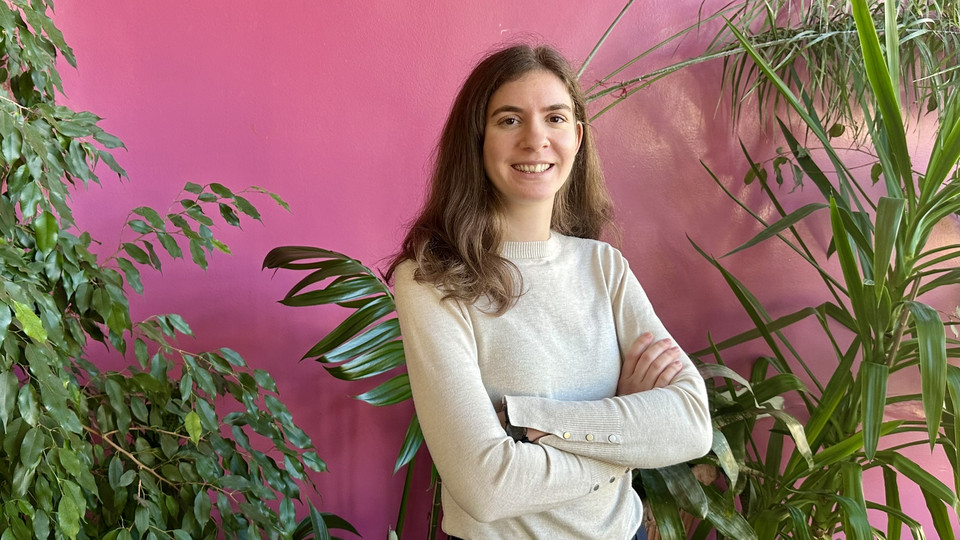
VBC PhD awardee Lucija Orlić. © Max Perutz Labs
During meiosis, homologous chromosomes exchange DNA through recombination, generating intermediate structures known as double Holliday junctions that must be resolved before cells divide. In her PhD in the Matos lab, Lucija Orlić investigated how different DNA repair enzymes process these structures and showed that MutLγ acts faster than competing pathways, helping explain why it preferentially generates the crossovers required for accurate chromosome segregation. Parts of this work were recently published in Nature Communications, with Lucija as first author, revealing an unexpected structural role for Top3 in preserving recombination intermediates so they can be efficiently resolved into crossovers. She explains: “Our findings show how the timing and coordination of different pathways ensure that meiotic recombination intermediates are resolved in the right way and at the right time.” Lucija first came to Vienna for an internship in autumn 2019 and started her PhD at the Perutz in September 2020 after studying Molecular Biology at the University of Zagreb.