

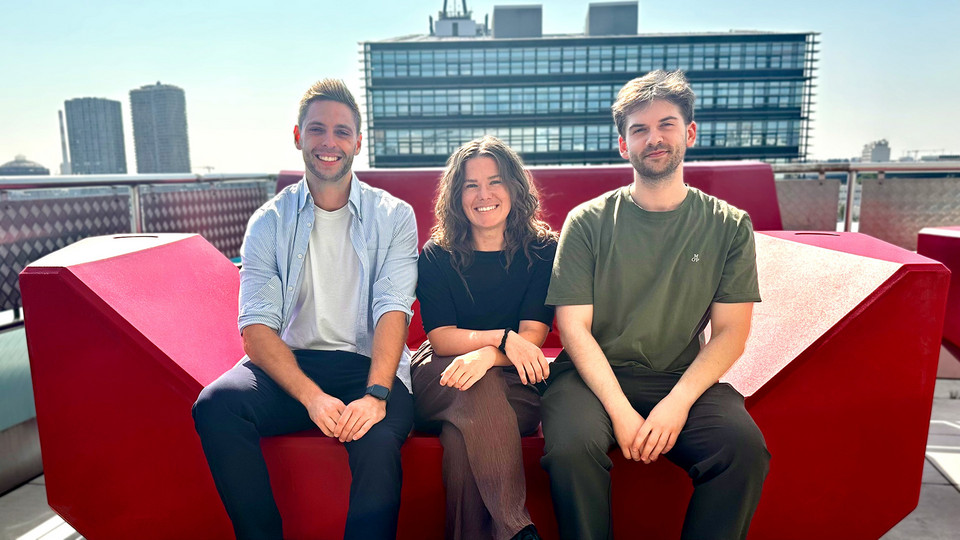
The three ÖAW DOC fellows: from left to right Moritz Becker, Carla Simon, and Leon Schmidt. © Max Perutz Labs
Accurate termination of gene transcription is just as important as its initiation, yet the mechanisms maintaining gene boundaries at termination sites remain incompletely understood. In her project, Carla Simon will investigate how the protein DIDO3 controls transcription termination and why failures in this process impair the development of neurons. Building on recent discoveries from the Slade lab, she will uncover how DIDO3 suppresses transcriptional readthrough and how defects in this mechanism disrupt neuronal differentiation. Carla explains: “We know that precise control of gene expression is essential for healthy brain development, and by understanding how DIDO3 ensures proper transcription termination, we hope to reveal fundamental mechanisms that underlie neuronal differentiation and, ultimately, neurodevelopmental disorders.” Carla completed her undergraduate studies at the University of Bonn before joining the Slade lab at the Max Perutz Labs in 2024 to pursue her PhD.
About the Slade lab
Viruses with only a handful of genes depend on a remarkable network of interactions with their host cells to survive. Leon Schmidt explores how anelloviruses – small, persistent viruses carried by most people without causing disease – interact with human cells despite their minimal genomes. Using a synthetic biology approach combined with high-throughput omics technologies, he will compare how different viral proteins engage host factors to distinguish conserved from virus-specific functions. “Although anelloviruses are among the most common viruses in humans, we still know surprisingly little about how they function at the molecular level,” says Leon. “By systematically mapping their interactions with host cells, we hope to uncover fundamental principles of how these minimalist viruses exploit cellular machinery.” Leon completed his Bachelor's degree in Biochemistry at the West University of Timișoara, Romania, before moving to Vienna for his Master's studies. He joined the Hein lab in 2023 for his Master's thesis and has continued there as a PhD student since 2025.
One of the earliest steps in human development is the transition of the naïve epiblast to a so-called formative state during implantation of the human blastocyst. This cell-fate transition enables the formation of the body’s diverse tissues, yet the underlying process remains poorly understood. Moritz Becker aims to dissect the molecular mechanisms that control this critical developmental switch using naïve human embryonic stem cells as a model system. By combining genome-wide CRISPR screens with transcriptomic and chromatin-based analyses, he aims to identify the genes that drive cells out of the naïve state or help preserve their earliest developmental identity. “This transition is a defining moment in early human development, yet many of the underlying mechanisms remain unknown. By uncovering the factors that regulate it, we hope to better understand human development and improve stem cell models for future research”, says Moritz. Moritz earned his Bachelor's and Master's degrees in Biochemistry at the University of Würzburg, Germany, and joined Martin Leeb’s lab at the Max Perutz Labs as a PhD student in 2023.